Shift-Left Code Quality: Inside DebtDrone CLI 2.0.0 and a Dual-Mode Architecture
Technical debt is a silent tax on engineering velocity. For developers, it manifests as sprawling, unmaintainable monolithic functions that make feature work feel like navigating a minefield. For business leaders, it translates to delayed release cycles, increased bug rates, and higher developer churn. By the time technical debt is flagged in a pull request review, the cost to fix it has already multiplied.
As launch of the full DebtDrone enterprise platform approaches, the goal is to empower engineering teams to identify and eliminate technical debt before code ever leaves local machines.
Today marks the release of DebtDrone CLI 2.0.0: a major architectural milestone that transforms the statically-linked Go binary into a dual-purpose powerhouse. Version 2.0.0 introduces a rich, interactive Terminal User Interface (TUI) alongside the battle-tested headless mode.
Crucially, DebtDrone CLI 2.0.0 is powered by the exact same core analysis engine that will drive the upcoming DebtDrone enterprise platform. By upgrading to 2.0.0 today, developers get an early, hands-on experience with the enterprise-grade engine designed to change how organizations manage code quality.
Here is a look at the architectural decisions behind this major release, and what it means for engineering velocity.
One Core Engine, Two Strategic Fronts
When designing the 2.0.0 evolution of the CLI, a UX dilemma emerged. Human developers need interactivity, progressive disclosure, and visual context to explore codebases locally. Automated CI/CD pipelines, however, require strict determinism, structured data (JSON), and standard POSIX exit codes.
Rather than maintaining two disparate tools, version 2.0.0 unifies them. The DebtDrone 2.0.0 binary now operates in two distinct modes:
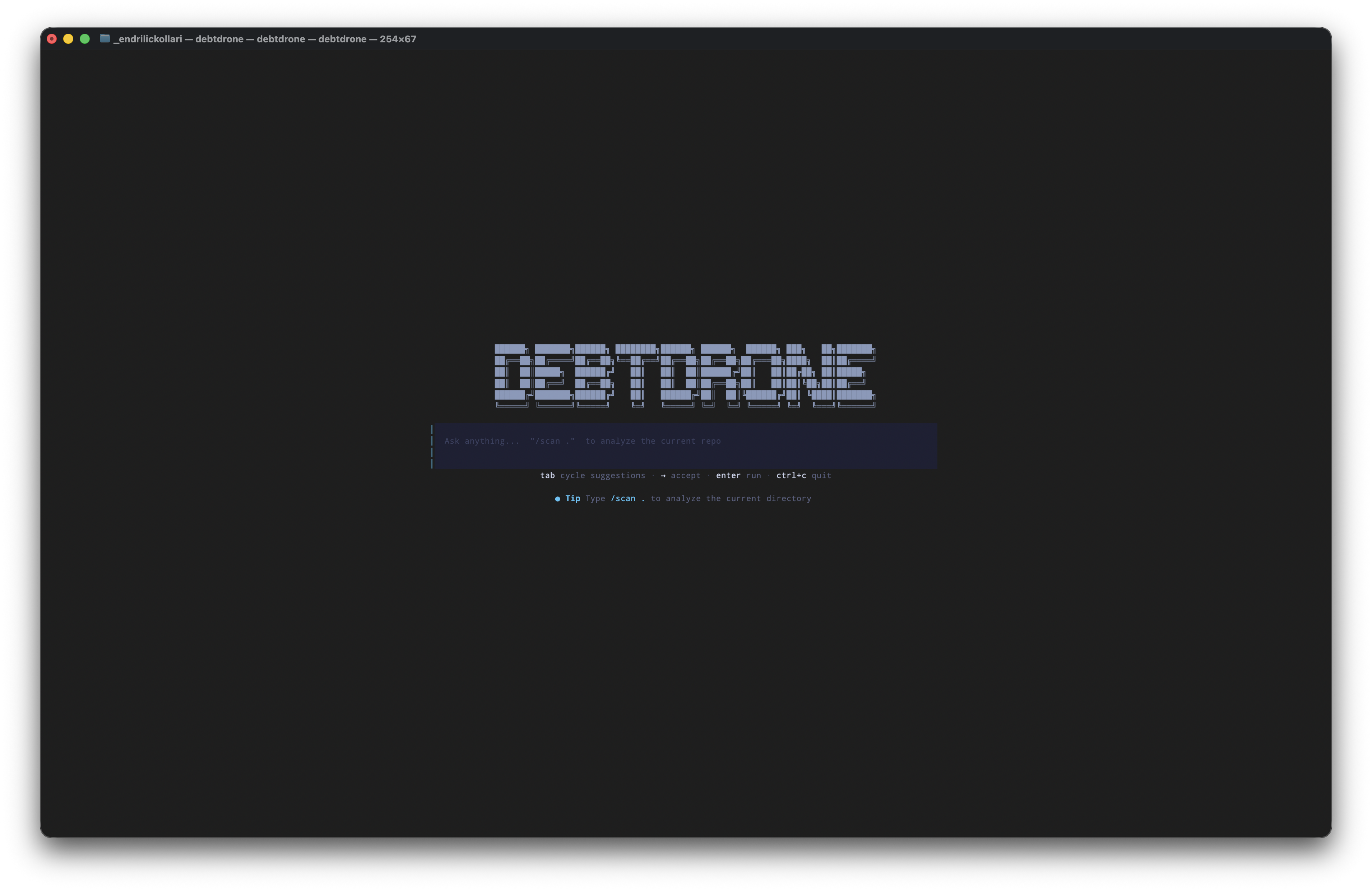
- The Interactive TUI (For Humans): Newly introduced in 2.0.0 and built on Bubble Tea, this provides a beautiful, responsive master-detail terminal interface. Developers can explore complexity metrics and track historical debt reduction locally without breaking flow or leaving the terminal.
- The Headless CLI (For Machines): Built on Cobra, this robust executable seamlessly integrates into CI/CD environments to enforce strict quality gates and generate machine-readable reports.
The Architecture: Hexagonal Design for Future-Proof Scaling
Adding a full-featured TUI to an existing CLI tool often results in a tangled, unmaintainable codebase. To ensure the analysis engine remains entirely decoupled from user interfaces, version 2.0.0 was engineered using a strict Ports & Adapters (Hexagonal) Architecture.
Because the core engine operates independently of whether results are displayed in a terminal, written to a JSON file, or rendered on a cloud dashboard, the 2.0.0 TUI was shipped rapidly without touching the core analysis logic.
The architecture is split into three layers:
- The Domain Layer: The heart of DebtDrone. It contains the pure business logic that calculates
ComplexityMetricdata and translates abstract code flaws into actionable, quantifiable "debt minutes"—providing product managers and tech leads a concrete metric for sprint planning. - The Ports: Go interfaces that define what the application needs (e.g., an
Analyzer). - The Adapters: The concrete implementations. The CLI ships with 14 language adapters powered by tree-sitter, alongside in-memory storage adapters designed to seamlessly swap to SQL backends for the enterprise platform.
Scaling the Developer Experience: The Nested Router Pattern
Terminal UIs can fall victim to state bloat, where application state is piled into a single structure, leading to sluggish performance.
To ensure the DebtDrone 2.0.0 TUI remains lightning-fast even when scanning massive enterprise repositories, a Nested Router Pattern was implemented. The root state machine acts purely as a traffic controller, delegating isolated tasks to child models (like the Scan View or the History Browser). Communication happens entirely through event-driven message passing.
For the developer, this means zero UI lag, seamless transitions between real-time scanning and historical comparisons, and a frictionless experience that makes reducing technical debt inherently rewarding.
CI/CD Quality Gates: Automating the Standard
While the TUI empowers developers to explore, the headless CLI empowers engineering leadership to enforce.
By integrating DebtDrone CLI 2.0.0 into a pipeline, code merges that introduce unacceptable levels of technical debt can be blocked automatically:
      - name: Run DebtDrone Quality Gate
        # Fails the PR automatically if high or critical debt is introduced
        run: debtdrone scan ./ --format=json --fail-on=high
This represents the ultimate "shift-left" strategy. Setting --fail-on=high transforms the CLI into an automated gatekeeper. If a PR contains a function exceeding team cyclomatic complexity thresholds, the pipeline fails (os.Exit(1)).
By committing a .debtdrone.yaml configuration file to a repository, the rules a developer sees locally in the TUI perfectly match the rules enforced by the CI pipeline. This eliminates the friction of subjective code reviews and reclaims engineering time.
The Road Ahead: From Local to Enterprise
DebtDrone CLI 2.0.0 is a significant leap forward. The enterprise-grade core engine experienced in the terminal today is the same engine that will power the comprehensive DebtDrone platform launching shortly.
By upgrading to 2.0.0 and establishing local config files now, teams can begin standardizing quality gates, mapping technical debt, and improving engineering velocity immediately—ensuring they are perfectly primed to scale these insights across the entire organization when the full platform is available.
Updating binaries, running /scan in complex repositories, and experiencing the new standard of technical debt management is possible today. For complete installation instructions and deep dives into configuring CI/CD pipelines, explore the Official DebtDrone CLI Documentation.