DebtDrone 2.0: Bridging the Gap Between Code Complexity and Business Risk
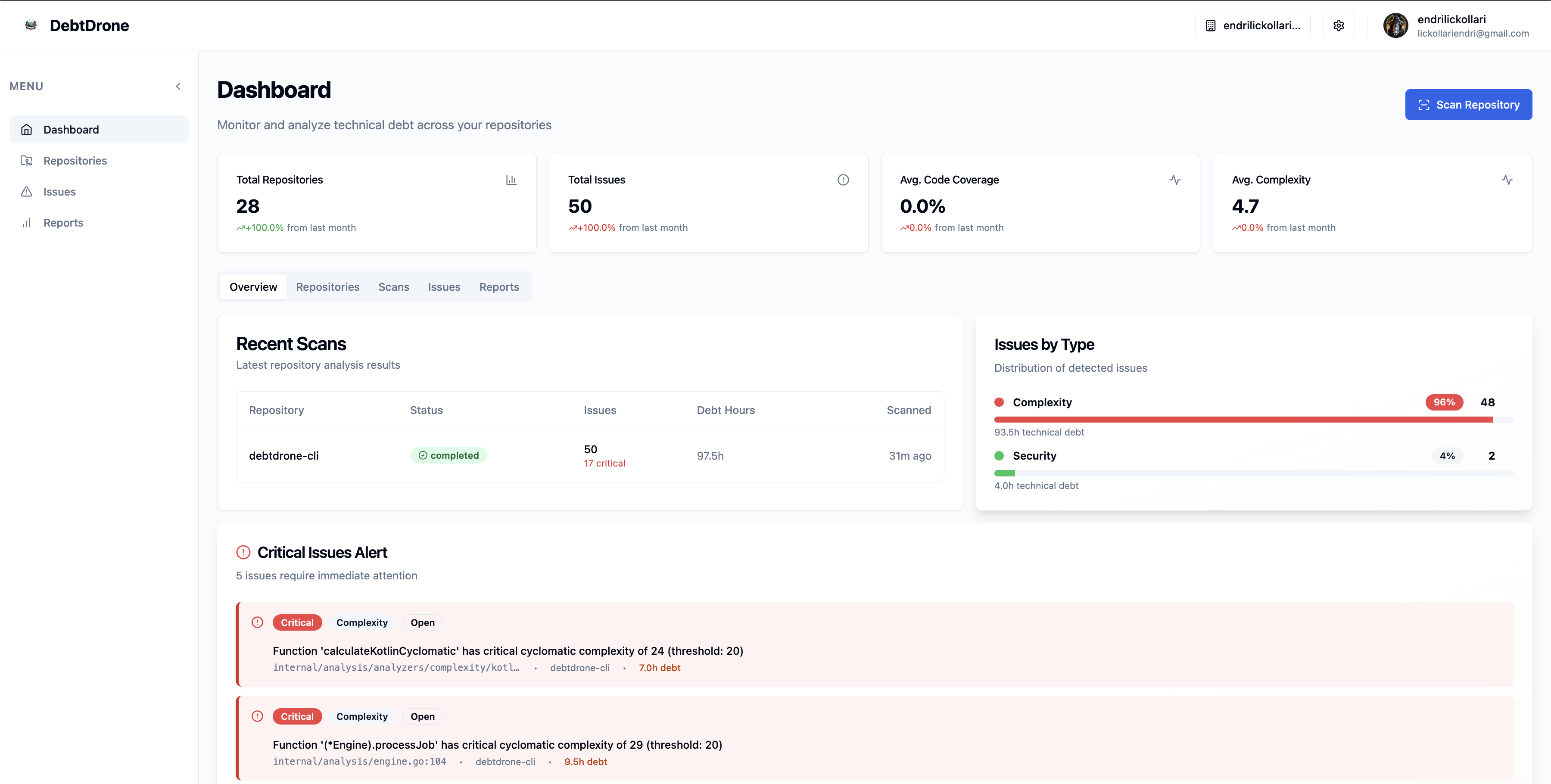 A preview of the upcoming DebtDrone Dashboard: translating code metrics into business insights.
From a Single Binary to a Cloud Platform
A few months ago, I introduced DebtDrone as a CLI tool. It was—and still is—an engineering feat I am incredibly proud of: a high-performance, AST-based static analyzer written in Go. I designed it to ingest a repository, parse over 11 languages using Tree-sitter, and calculate Cognitive Complexity scores in milliseconds.
But as I used the tool myself, I realized a CLI has a fundamental limitation: it only provides a snapshot.
It tells you that payment_service.go is complex today. It doesn't tell a CTO if the refactoring sprint actually paid off. It doesn't warn a founder that their platform is becoming so brittle it might collapse under load.
That realization drove me to start building DebtDrone SaaS. I am taking the core analysis engine and wrapping it in a modern, scalable cloud architecture to track the lifecycle of technical debt.
Architectural Deep Dive: The Go Backend
To deliver accurate insights, the underlying engineering must be flawless. I stuck to my roots for the backend while embracing a modern frontend ecosystem.
The Engine: Concurrency at the Core
The heart of the SaaS is the Engine. I didn't want a simple serial processor; I wanted something that could chew through queues of repositories efficiently.
I engineered the system using Go's native concurrency primitives. The engine initializes with a configurable number of workers that listen on a job queue.
// From backend/internal/analysis/engine.go
func (e *Engine) Start() {
    for i := 0; i < e.workers; i++ {
        e.wg.Add(1)
        go e.worker(i)
    }
    log.Printf("🚀 Analysis Engine started with %d workers", e.workers)
}
When a user imports a repository, a job is submitted to this queue. A free worker picks it up and begins the analysis. This "fan-out" architecture allows the platform to scale horizontally as user load increases.
Smart Incremental Analysis
One of the biggest challenges in static analysis is speed. Cloning and analyzing a massive monorepo takes time. To solve this, I implemented Incremental Analysis.
I track the LastAnalyzedCommitHash for every repository. When a new job comes in, the engine compares the current commit hash with the previous one. If they differ, I calculate the diff, ensuring developers get near-instant feedback on their latest commits.
AI-Powered Remediation
I don't just want to find problems; I want to help fix them to lower the remediation cost. I am currently integrating an AIService that connects to LLMs.
When DebtDrone identifies a "Critical" complexity issue, it doesn't just flag it—it effectively "pairs" with your developers. By leveraging generative AI, the platform instantly drafts a production-ready refactor, automating the path from "spaghetti code" to clean architecture.
The Frontend: React for Data Visualization
For the user interface, I chose React with TypeScript. Technical debt is data-heavy—histograms of file complexity, trend lines over time, and drill-downs into specific functions.
I am utilizing a component-driven architecture to build responsive visualizations. The Debt Trend Chart and Hotspot Heatmaps ensure that high-level metrics are instantly understandable for non-technical stakeholders while remaining detailed enough for developers to take action.
Seamless Integration with GitHub
I know that friction kills adoption. If a developer has to manually configure a CI pipeline just to see metrics, they won't do it.
That’s why I am building DebtDrone SaaS with first-class GitHub integration. Using the GitHub OAuth flow, users will be able to log in to DebtDrone instantly, select their organization, and import repositories with a single toggle.
While I am launching with GitHub first, I designed the internal/oauth and sync_service packages to be provider-agnostic, with GitLab and Azure DevOps integration on the immediate roadmap.
Why This Matters
Technical debt is often treated as an abstract concept. I built DebtDrone to make it concrete for every role in the organization.
For Business Leaders: Protecting ROI
If you are a CEO or Stakeholder, "cyclomatic complexity" sounds like jargon. But risk and cost do not.
DebtDrone translates code issues into financial reality. In the engine, I explicitly calculate TechnicalDebtHours based on a configurable CostPerPoint.
- Hidden Costs: Every hour developers spend deciphering complex code is an hour not spent building features. DebtDrone quantifies this waste.
- System Stability: Unmanaged debt leads to outages. By tracking complexity trends, you can identify "ticking time bombs" in your infrastructure before they crash your system on Black Friday.
For Startups: Velocity vs. Stability
In the early days, you trade quality for speed. That is valid. But you need to know when to pay that debt back. DebtDrone provides the visibility to say, "Our complexity score has doubled in the last month; we need to pause features for a week and refactor to maintain our speed."
For CTOs: Strategic Oversight
You manage people and products, but you can't read every line of code. DebtDrone gives you high-level KPIs:
- Risk Hotspots: Which files are most likely to break?
- Trend Analysis: Is the team writing cleaner code over time?
- Onboarding Friction: Identifying overly complex modules that will stump new hires.
Conclusion
The DebtDrone CLI gave developers a microscope. The DebtDrone SaaS will give organizations a map.
I am hard at work finalizing the platform for its upcoming release. Whether you are a developer tired of spaghetti code or a business leader worried about the bottom line, DebtDrone is being built to solve your problem.
Stay tuned for the launch! 🚀